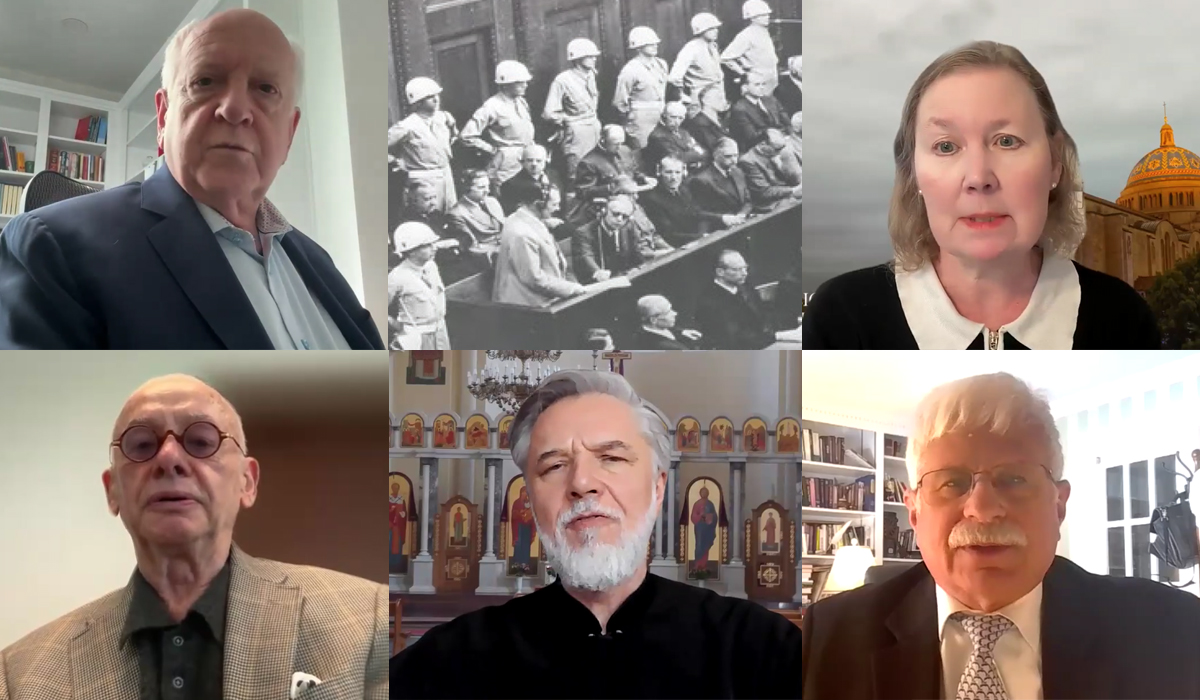
Washington, DC – January 29, 2026 – The Catholic University of America hosted a thought-provoking discussion titled A New World Order? The Future of the Nuremberg Principles: Workshop on International Criminal Law and Global Justice as Wars Rage Around the World. The event was a collaborative effort by the University’s Institute for Policy Research, Catholic Law’s Comparative and International Law Institute, and the Law School’s International Law Students Association.
The workshop examined the historical shift from an “Old World Order” grounded in sovereignty and early just-war thinking to the post-World War II “New World Order”, defined by the Nuremberg Principles, according to which even heads of state can be held accountable for their crimes. Panelists asked whether the Nuremberg framework still offers functional applications of accountability, or whether its ideals are being tested by modern geopolitical realities.
The discussion featured Michael Bazyler, Professor of Law and the 1939 Law Scholar in Holocaust and Human Rights Studies at Chapman University; Robert Destro, Professor of Law at Catholic Law and former U.S Assistant Secretary of State for Democracy, Human Rights, and Labor (2019-2021); and the Very Rev. Dr. Mark Morozowich, Associate Professor in the School of Theology and Religious Studies and Chair and Director of The Bishop Losten Center for Ukrainian Church Studies. The Workshop was moderated by Herbert Reginbogin, Collegiate Fellow at the Institute for Policy Research and Professor of International Law at Istanbul Kent University, and Susanna Frederick Fisher, Associate Professor at Catholic Law and Director of the Comparative and International Law Institute.
Father Mark Morozowich discussed the morality of Russia’s war by emphasizing that this was a fight over territory but an ideological assault on Ukraine’s right to exist. He introduced the notion of “Russkiy mir” (“the Russian world”), which Russians use as a pretext for this ideological war. “Russkiy mir”, a religio-national ideology promoted by the Russian Orthodox Church and taken up by the Russian state, is a geopolitical doctrine that blurs and relativizes borders by portraying Russia as a transnational civilization linked by the Russian language, culture, and Orthodoxy, which in turn is used to claim a “special” Russian mission and influence beyond Russia’s borders.
Father Mark then looked at the situation of the Russian war in Ukraine within the wider context of the Nuremberg Principles discussed. He noted that Nuremberg was meant to show that perpetrators of mass crimes can be named and held accountable. However, at the same time, history contains painful examples of selective accountability, including the failure to hold the Soviet Union responsible for mass atrocities in Ukraine. He reminded the audience of the Holodomor, deportation into the Gulag, and the Soviet destruction of the Ukrainian Greek Catholic Church, including the arrest of its hierarchy in 1945 and its forced liquidation in 1946, followed by the imprisonment of thousands of believers.
Finally, Father Mark also reminded the participants of the workshop that the war did not begin in 2022, but in 2014, with the illegal annexation of Crimea and the start of armed conflict in the Donbas. He pointed to international commitment meant to prevent exactly this kind of aggression – the Budapest Memorandum (1994) and the principles of the Helsinki Accords – and argued that Russia’s action represents a clear violation of those promises and of the basic rules meant to protect sovereignty and human rights.
In the end, the panelists concluded that the Nuremberg Principles were intended to make the promise of “never again” enforceable; however, this commitment remains fragile when enforcement is selective. Ultimately, the panel concluded with affirmation that Nuremberg cannot be regarded as a static historical monument but as an ongoing test, one that current conflicts are actively evaluating.
The series continues Tuesday, February 24, 2026, at 12:30 PM, exploring the shifting dynamics of international law and global justice.
Nazariy Dmyterko